
Rotary Tables








ROTARY TABLES ENABLE MULTI-AXIS MACHINING
 Rotary tables mounted on machine tools add a rotational axis to the machine’s capabilities. This allows for increased flexibility and facilitates the rotation of workpieces during machining that is necessary for multi-axis machining, contouring, and indexing. So, using a 4th axis rotary table or 5th axis rotary table can contribute to increased productivity, precision, and the ability to produce intricate and complex parts.
ROTARY TABLES PROVIDE RIGIDITY, ACCURACY, AND DURABILITY
 Nikken rotary tables are recognized worldwide for their wear-resistance, rigidity, and high-speed rotation. Nikken rotary tables are designed and built to provide high accuracy, increased production, and a trouble-free long life.
INNOVATIVE CARBIDE WORM SYSTEM FOR ROTARY TABLES
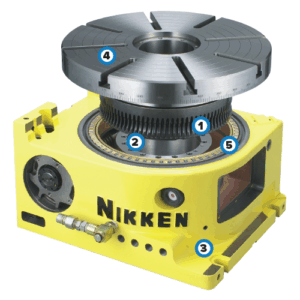 Unique to Nikken rotary tables is the innovative and patented carbide worm system comprised of a carbide worm screw, ion nitrided worm wheel (HV930), and hardened steel bearing surface (HRC58-60). The V grade solid carbide worm screw helps to ensure high rigidity and virtually eliminates wear. Compared with traditional worm system combinations (consisting of phosphorus bronze and aluminum bronze), wear is reduced by up to 8 times, and overall accuracy is substantially increased. Additionally, the worm wheel has specially hardened, ion-nitrided treated teeth that eliminate sliding friction.
1 - Worm Wheel
The fine pitch of the NIKKEN worm wheel contributes to 4 arc second repeatability. NIKKEN’s unique construction shrink fits the worm wheel onto the solid faceplate and quill body.
The NIKKEN worm wheel and screw system in conjunction with the tables higher speed rates create a hydro-static high pressure oil film, virtually eliminating the wear between the gears.
2 - Worm Screw
The NIKKEN worm screw is a combination of special hardened steel and custom-made carbide. Consequently, and ultimately a benefit, friction between the screw and worm wheel is eliminated. The thread ground carbide worm gear and honed steel worm wheel are hand matched and paired to maintain maximum thread engagement and rotation accuracy (this also adds to the rigidity overall).
3 - Casting
NIKKEN rotary tables utilize fine grain high-density grey cast iron. These castings offer long-term stability, low distortion with high strength and rigidity. The castings are rough machined, after which a period of 30 days is allowed for the casting to stabilize before the rotary table is prepared and put through the finish machining process.
4 - Faceplate
Our design features a much shorter distance from the faceplate to the gear. This means that greater torsional forces can be sustained. Braking is applied directly to the spindle, which is a mono block construction incorporating the faceplate, adding greater rigidity overall.
5 - Radial Bearing System
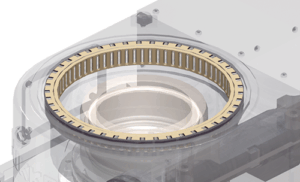 Located directly under the edge of the faceplate is the Radial Bearing System. This position maximizes load distribution. We also incorporate a Teflon seal in lieu of an ‘O’ Ring. The bearings are handpicked and matched (in increments of 1 micron) between rotary table and faceplate assembly, ensuring the utmost rotation accuracy and elimination of unnecessary movement between the two parts.
ELIMINATE BACKLASH & FRICTION IN ROTARY TABLES
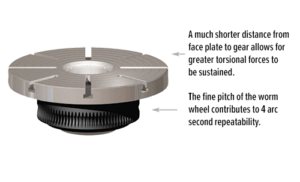 Nikken’s unique design shrink fits the worm wheel onto the solid faceplate and quill body. This along with the hand pairing of the carbide worm screw eliminates backlash.
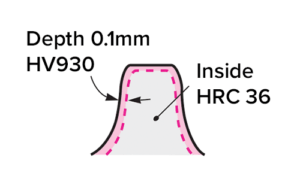 The material used for the Nikken worm wheel is custom made steel, specially hardened and ion nitrided on the teeth. Consequently, friction between the gears is eliminated.
ROLLER EVOLUTION DRIVE (RED) ROTARY TABLES
 Equipped with a new red mechanism, Nikken’s Roller Evolution Drive (RED) rotary tables are designed with a new drive system for high speed, high rigidity, and high accuracy.
 Watch the video to discover the benefits of using RED rotary tables, or read below:
High Rigidity Mechanism
In the standard roller CAM system, CAM shift (input gear) and turret (output gear) are installed horizontally. However, the Nikken red rotary table has a mechanism that is installed vertically resulting in approximately a 25% increase in the transmission efficiency which translates into higher rigidity and higher precision.
No Backlash Mechanism
Maintenance Free
Highly Efficient Roller Transmission for Production
Machining Time Reduction Due to Brakeless Machining
Advanced Design with Tilted Cover
VIDEOS: HOW LYNDEX-NIKKEN ROTARY TABLES PROVIDE OPTIMAL MACHINING SOLUTIONS